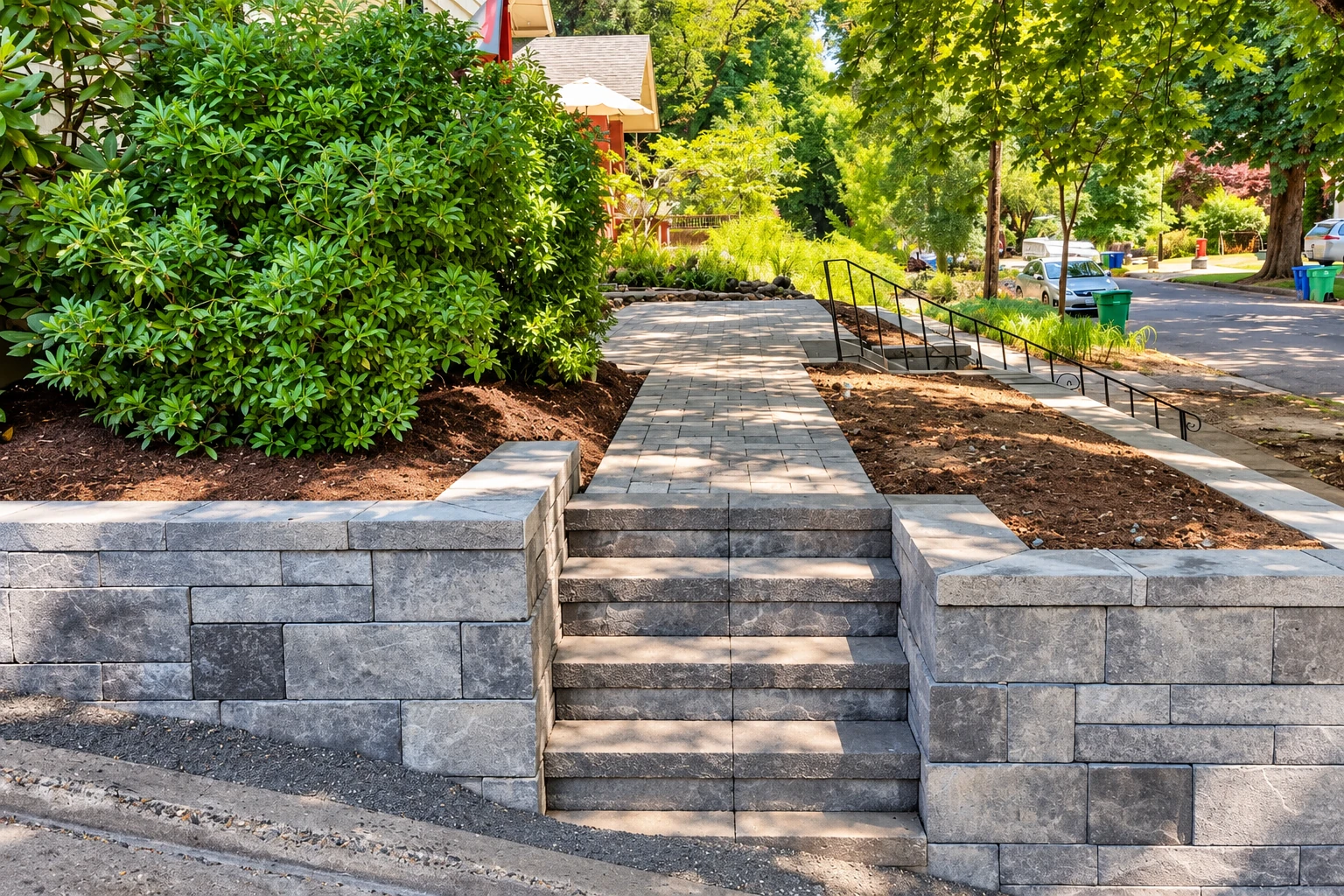
Concrete retaining walls in Port Angeles WA - built to drain and hold your slope
A bank slumping onto the lawn, a yard too steep to use or an old wall leaning? We pour a wall with drainage planned behind it.
Do I need a concrete retaining wall, and what goes into one?
A concrete retaining wall in Port Angeles holds back a slope so you can use the ground above and below it. We build it as a poured wall on a concrete footing with rebar inside, the steel bars that give it the strength to hold the soil, and we put packed backfill and drainage behind it so water doesn't build up pressure against it.
Most calls start with a bank that's slumping onto the lawn, a yard too steep to use or an old wall starting to lean, and before I say much about concrete I want to know what you'd like the ground for. The price moves with the wall's length and height, the type of wall your lot has room for, how easy it is to get forms and a truck to the spot and how much digging and drainage the site needs. The schedule mostly turns on settling the site questions and anything the city needs before we pour. If the wall needs concrete steps through it, we plan those at the same time, and your estimate spells out what's included so you know what you're paying for.
What happens after you call about a retaining wall in Port Angeles?
Call or send us a note
Call (564) 203-7120 or use the form on this page, and we'll get back to you to set a time for me to come out. Tell us roughly where the wall would go so I know what to look at.
I walk the site with you
I come out myself, look at the slope and where your water runs, and ask what you've got planned for the ground above and below the wall. A rough idea of the length and height you want helps me size it.
You get a written estimate
The estimate lists the footing, the wall, the backfill and the drainage, and says plainly what's in it and what isn't. That way you can line it up against other bids and see who left the drainage out.
We prep, pour and walk it
Once you're ready, we sort out anything the city needs, dig and prep the ground and pour, and I'm on site with our crew the whole way. When it's done, we walk the finished wall together. Satisfaction guaranteed on every job.
How we build a concrete retaining wall, and the work that comes after it
I ran a landscaping business for years before I started pouring concrete here in 2017, so I look at where the water goes before anything else. What happens behind a wall matters as much as the wall itself, and on a lot near the water or a slope we settle the site questions with you before the wall gets designed. The state Department of Ecology says landslides happen along the bluffs of the Olympic Peninsula, and its guidance tells owners not to cut into a steep slope or dig out the bottom of one. One retaining wall guide also lists organic and expansive soils as poor ground to build on, so I want to know what's under the footing before we plan it. Then we dig, set the footing and rebar, build the forms and pour, and the forms stay on while the concrete cures, which is the slow hardening it needs to reach its strength. Behind the wall we backfill in packed layers and plan the whole path water takes, from the backfill to the outlet. When budgets get tight, people want to trim the base and the drainage because nobody sees them, and I'd rather give up a fancy face finish, since water and settling are what move a wall. We're based in Port Angeles and work in Sequim and the cities around it, and sloped lots come up all over.
A wall usually opens up flat ground for something else, and that's the part I like figuring out. If the new level spot is headed for a shop or an addition, we handle the concrete floor installation and match the slab to the floor going on top of it. If it's making room for a pool, we can pour the concrete pool decks too, so the deck and the wall get planned to handle water together.
Get a written estimate for your retaining wall
We reply within one business day to set a time, and I come out myself for a free in-person estimate, with no pressure to book. Once you've read it over, you decide what happens next.
Port Angeles retaining wall questions
How much does a concrete retaining wall cost in Washington?
A statewide pricing site says a retaining wall in Washington usually costs about $30 to $50 per square foot. Where yours lands depends on the project itself, where the site is and how easy it is to reach, how complex the design is and how much work the job covers. Your own number comes from the estimate after I've seen the lot.
Will a retaining wall near the water in Port Angeles need a shoreline permit?
It can, because the City of Port Angeles says any development within 200 feet of a regulated shoreline may trigger one or more shoreline permits, reviewed by the city and in many cases by Ecology too. A shoreline permit is triggered when construction or fill in shoreline jurisdiction costs more than the current $8,504 threshold, and building permit applications go to the city. If you're not sure which application you need, the city's permit staff will meet with you if you book a time, or you can reach them at permits@cityofpa.us or 360-417-4817. We look early at whether the work reaches city land, and when a permit is needed we handle the paperwork with the city or help you get your questions to its permit staff.
What causes water pressure to build up behind a retaining wall?
Water pushes on a wall when it collects in the soil behind it with no clear way out. A wall's drainage needs a complete path, where water reaches a drainage zone, passes through a filter, enters a collector or a weep and drains to a suitable outlet. Weep holes, the small openings through the wall, can't make up for clogged backfill or a blocked outlet, so compare how each bid handles the whole path.
How do I check a concrete contractor's license in Washington?
Use Washington L&I's contractor verification tool, which shows whether a contractor has an active license and is bonded and insured for damages that may occur. We're licensed and insured, and I'd rather you look us up than take my word for it.
What is the best way to choose between a cantilever and a gravity retaining wall?
Start with how much yard you can give up, because a cantilever wall takes a smaller footprint than a gravity wall, which holds the soil back mostly with its own weight. The catch is that a cantilever wall is more complex to design and build, and it costs more. On a tight lot that usually means paying more to lose less yard, and I'll lay out both options for your site.
How do I know if my retaining wall needs a closer look after heavy rain?
Walk the wall after heavy rain or any change to the site, and look for blocked outlets, erosion, new seepage, settling and any movement in the wall. A change in any of those is your cue to get it looked at more closely. Don't drill extra holes to let water out, because that can affect the wall's reinforcement, waterproofing or stability, so it needs review by the professional responsible for the wall.
Other concrete work that goes with a wall
Concrete floor installation
A wall that cuts a level pad into your slope leaves room for a garage, shop or studio, and that building needs a floor slab poured on solid ground.
Concrete pool decks
If the ground above or below the new wall is headed for a pool, the deck is the next pour and works best planned alongside the wall.
Send us a look at your slope
Call (564) 203-7120 or email office@concreteportangeles.com with the wall's rough length and height, a few photos of the slope and whether the lot sits near the shoreline, so I show up already thinking about your lot.